
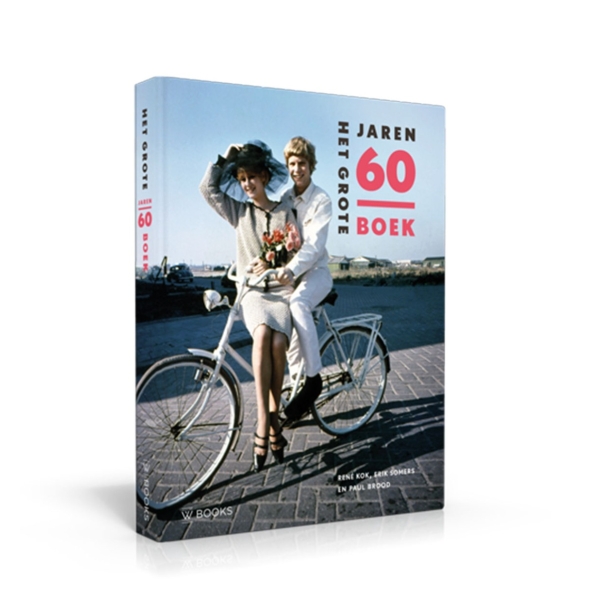
Het Grote Jaren 60 Boek - Paul Brood, René Kok en Erik Somers
| EAN: | 9789462586079 |
Product information
Language: Dutch, 368 pages.
400 images in color and black and white.
Flower power, Provo movements, hippies, happenings, The Beatles and The Rolling Stones, cruising on your ‘belly slider’ or Mobylette — those were the days, the boundless sixties.
If you were young during that time, the memories are vivid, often tinged with nostalgia. For those who came later, the decade is viewed from a greater distance, framed by the celebrated highs and infamous lows often revisited in popular culture. But was it truly a revolutionary era, or have our recollections and contemporary accounts become too idealized? The Big Sixties Book offers a more nuanced perspective — sometimes surprising, often different from what we thought we knew.
Our collective image of the sixties is deeply shaped by the work of photojournalists. Figures like Piet Boonstra, Dolf Henneke, Fotopersbureau Het Zuiden, and Ben van Meerendonk with his Algemeen Hollands Fotopersbureau provided newspapers with striking visuals of the day’s events. Photographers like Joep Friezer, Theo Meijer, and Tiemen van der Reijken, along with the major agencies Anefo and ANP, played vital roles as well. In Zeeland, Jacqueline Midavaine captured the rhythms of everyday life — because life, of course, simply carried on. Magazines featured enticing studio shots of the latest fashions and interiors, while Spaarnestad pushed printing quality and color reproduction to new heights. And television began to expand our awareness of the world beyond our own borders.
This was a time when pre-war and post-war generations encountered — and often collided with — one another across every social space. Views changed just as visibly as the streets themselves. Long hair, short skirts, roads increasingly dominated by cars. A growing economy met a housing shortage. Traditional gender roles gave way to the push for personal freedom and self-expression. The Big Sixties Book captures the moment when the fifties were finally left behind, and society stepped — sometimes tentatively — into a new future.
It was, without doubt, the dawn of the modern era.
Product specifications
Bought Together
-
{% for suggestion in suggestions %}
- {{ suggestion }} {% endfor %}
-
{% for product in products %}
-
{{ product.name }} {% if product.request_price !== 'Yes' %} €{{ product.price | convert_currency | money }} {% else %}
Price on request{% endif %}
{% endfor %}
-
{% for category in categories %}
- {{ category.name }} {% endfor %}
-
{% for page in pages %}
-
{{ page.title }}
{% endfor %}